FUTURE BUILDING/NEW YORK
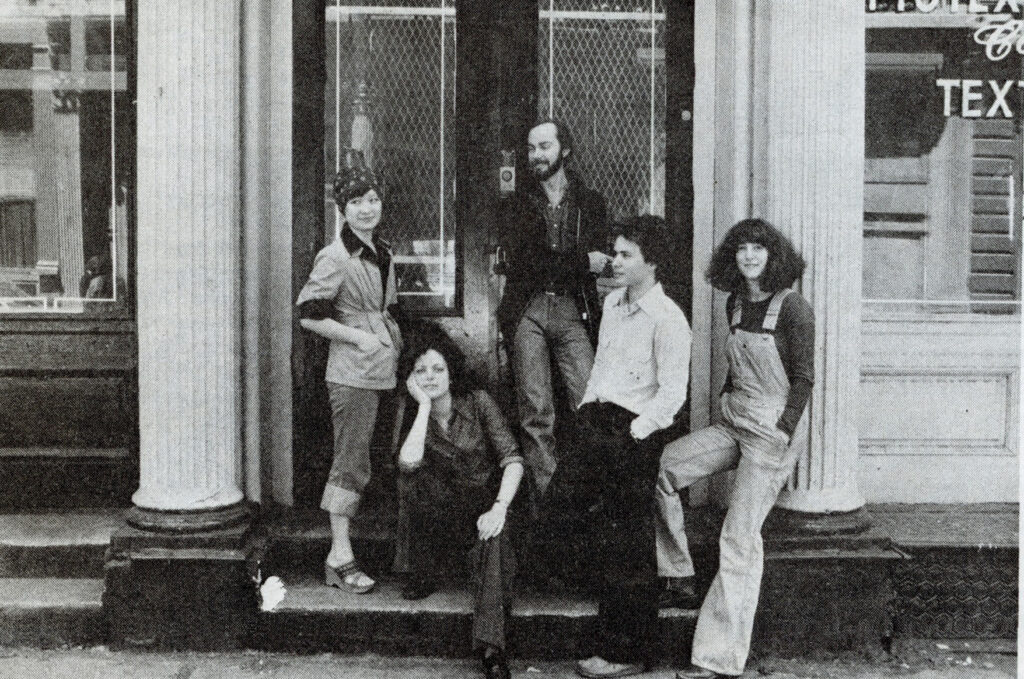
counterclockwise: Susan Logan (seated), Michiko Myamoto, Al C. Bryson, Allan Schwartzman, Marcia Tucker. photo credit: Warren Silverman
Marcia Tucker, clad in dungarees, a canary yellow peasant blouse and beaded red necklace, stalks the cramped quarters of the New Museum on Hudson Street in Manhattan, her black bangs bouncing as she twirls to greet an early morning visitor.
The phone is ringing, the frosted-glass outer office door (straight out of a Raymond Chandler novella) shuttles in volunteers, artists with bulky portfolios and stacks of mail. A perfume of frenzy is in the air. It’s a typical morning in the embryonic existence of the freshly incorporated, not-for-profit, New Museum, Ms. Tucker’s five year old “museum in the sky” daydream.
Canned from her position as painting/sculpture curator at the Whitney Museum in October, 1976 after eight years and 50 exhibitions, the 36-year-old art historian opened shop in January on the eighth floor of the Fine Arts Building, a re-christened loft emporium of avant-garde theater groups and art galleries on the triangular patch of real estate called “Tribecca,” just south of Soho.
Fueled by unemployment compensation, cross-country lectures and guest curating, Ms. Tucker assembled a small (unpaid) staff of four (A.C. Bryson fund-raising and development, Susan Logan, Michiko Miyamoto and Allan Schwartzman) with additional volunteer help, she began a slide bank and library of contemporary art since 1970.
Retreating to her sanctum adjacent to the reception area (partitioned by another frosted glass door), the champion of the avant-garde/conceptual/minimal forces of new art, reflects on her radical foray into creating an institution, from scratch. “I don’t want to promise what I can’t deliver,” cautions Ms. Tucker, “and it will take me the rest of my life to deliver a new museum. It’s so nice not to have to defend the Whitney anymore—both the best and worst parts of that bureaucracy. I’m not interested in badmouthing but I’m happy to be out—an incredible relief. Two weeks after I was fired, instead of thinking of alternatives I did what I wanted. There are worse things than failure and this is a monumental task.”
Without exhibition space (the Hudson Street quarters are temporary), the New Museum had to travel a few blocks to Leonard Street for their first curated show at C Space, a wisp of underground gallery space run by Marina Urbach. Memory opened on May 10 and New Museum staffers flaunted their new navy blue hooded (you guessed it) “New Museum” sweatshirts while uncrating the baby blue inaugural catalogues.
Quoting from the catalogue—“We intend to show works of art which have not yet gained public visibility or acceptance and to present them within a critical and scholarly context. The New Museum’s first priority is to focus on living artists and the work they make; to this end, we are providing information about lesser-known artists on a national level.”
The most striking feature of the catalogue are the interviews with the show’s artists by members of the New Museum staff. Instead of marketable blurbs that usually wind up on the inside of glossy book jackets, the interviews weave a powerful tonic of visual jousting.
Staffer Michiko Miyamoto asks Kathering Sokolnikoff about her low-fire white clay “mosques” with miniature tree branches—
“M.M.: Your work tends to rely on washed-out colors. Why is this?
K.S.: In most cases I am greatly concerned with the form, and choose to leave many of the structures white because that is the color that least conflicts with form. And it produces at the same time wonderful tonal reflective rainbows of color in the light and shadow. Beyond this, many of the structures are from very hot countries where a white surface is essential to reflect the heat.”
For their first show the New Museum chose eight artists, a gesture brimming with historical metaphor. In 1908 at the Macbeth in New York City, eight independent American artists (including John Sloan, George Luks, Maurice Prendergast, Robert Henri, Ernest Lawson, Everett Shinn, William J. Glackens and Arthur B. Davies) had a group show and Gloria Vanderbilt Whitney purchased four of the seven paintings sold. Ms. Whitney and collaborator, Juliana Force launched the Whitney Studio Club at 8 W. 8th Street in 1918, a move that mushroomed into the Whitney Museum of American Art.
Whether Ms. Tucker & Co., are following the olympic footsteps of Whitney & Force is not particularly crucial. The New Museum’s commitment to the artist and not the corporation (a chilling reality in modern American museums) is an acid test gurgling with economic uncertainty.
“The best people in museums,” commented Ms. Tucker, “are booted out or kept down. I want to take risks, I want to learn things so you have to take chances. I don’t want to be around stupid people who don’t care about art, who are insensitive. I don’t want to deal with something ready-made anymore.”
Gesticulating the office air space with graceful jabs, Ms. Tucker rattled off her short term goals—“I want to pay my staff, to get another curator with completely different tastes than me and then another with a total difference of opinion. There is a lot of room for eccentricism in the context of recent art history. My tastes are not complete, there is no way to like everything.”
While the New Museum searches for space and sponsors, the avalanche of paper work generated by mail and phone requests for information on contemporary artists overloads the hard-pressed staff in Room 803 at 105 Hudson. The New Museum office is crammed with filing cabinets, Kodak compartment files, two over-sized oak desks, bulletin boards with grant announcements and a floor-to-ceiling bookshelf.
Allan Schwartzman, transplanted curatorial intern from the Whitney sifts through the morning mail while Ms. Tucker converses with one of the museum’s trustee’s, Jack Bolton, sporting a banker’s chalk-stripe suit, initialled attache case and with the eccentric accessory of a green rucksack strapped on his back.
While Bolton backpedals out of the narrow office, waving adieu, Director Tucker picks up a thread of conversation with Kent Hines, an artist who will be featured in the New Museum’s first curated show.
Jangling phones punctuate the scene. A stack of pink “while you were out” phone messages litter a desk corner. Director Tucker’s maxim of, “I want colleagues who are working because they like to,” seems apropos for the highly charged atmosphere of the barely pubescent organization. But fundraising at the new museum is not organized enough, according to one staff member during a phone interview. “We are moving very slowly and carefully,” the staffer said, and Ms. Logan confirmed, “It’s too soon to generalize. There are no percentage breakdowns. Our donations and contributions have been very small . . .”
A.C. Bryson, fundraising and development staffer, for the New Museum confirmed his colleagues comments and added, “We are not geared up for fundraising at this point. It’s been much too hectic here and we’re still in the formative stages. Check back with us in a month.” As one staffer wryly comments after the hullaballoo from a freshly slit contributors’ envelope subsides, “no other museum weeps when they get donations.”
JUDD TULLY is a New York based freelance writer, the author of Red Grooms, Ruckus Manhattan, published by George Braziller, New York, 1977.