The Boston Museum hosts a retrospective of the paintings of Fairfield Porter.
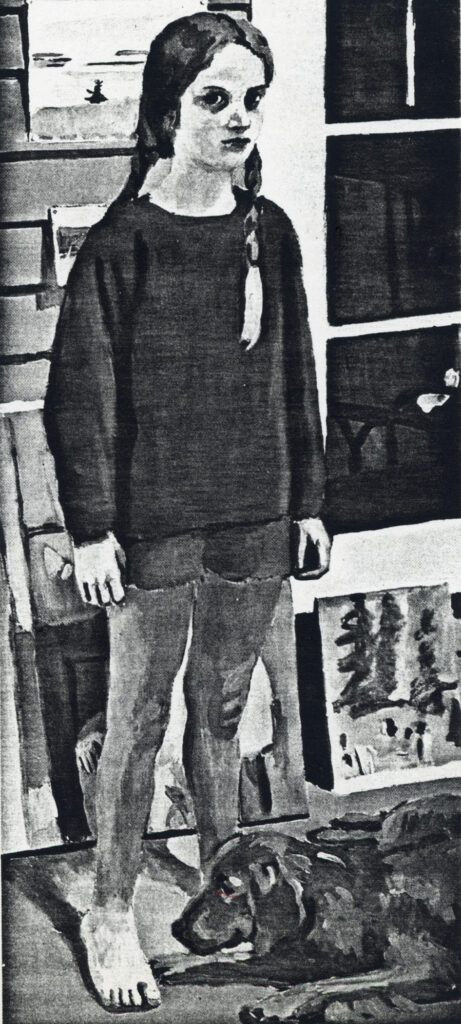
Lizzie and Bruno, 1970, oil on canvas, (60 by 24½ inches). The barefoot teenager is Porter’s youngest daughter. A truant blonde braid is temporarily located on the front of her sweatshirt. An arrangement of watercolors and still wet canvases lean on the wall behind her. Porter often chronicled scenes of domestic life, children growing up. Private collection Dr. and Mrs. Joseph M. Del Gaudio
“He is a painter’s painter. He singlehandedly brought the portrait back to America. He somehow, magically, brought the country to the city with an extraordinary incandescent light. He’d turn the asphalt around Cooper Union into a lavender meadow. Fairfield Porter is the only one who ever got that quality of illumination.” Those words, from painter Robert Dash, put the major Fairfield Porter retrospective at the Boston Museum in an interesting context.
When Porter died of a massive heart attack in the backyard of his Southampton home on September 18, 1975, he was sixty-eight and at the height of his painting creativity. The converted hayloft with the beautiful northern light that had served as his country studio since the family moved from New York City in 1949 was filled to the rafters with his paintings.
Prescott D. Schutz, who handles the artist’s estate at Hirschl and Adler Galleries in New York, and Kenworth Moffett, curator of twentieth century art at the Boston Museum of Fine Arts and organizer of the exhibit, have worked closely to collect paintings for the Porter retrospective. Both men are astonished at their near 100 percent success in obtaining Porter loans from the far-flung coterie of collectors, especially in light of the unusually long, eighteen-month tour. It is rare that a Porter turns up at auction, and even private overtures in excess of $100,000 have yet to dislodge a major Porter painting from a cognoscente. Schutz estimates the artist’s career output at 2,500 paintings. If you accept his scholarly judgment that Porter’s mature work jelled around 1950, the 125 paintings chosen for the retrospective represent the crown jewels of his awesome legacy.
The rich retrospective of Porter’s paintings opens on January 12 in the pristine West Wing of the Boston Museum of Fine Arts. The barrel-vaulted skylit ceiling of the new Graham Gund Gallery saturates the space with natural light. The setting mirrors Porter’s lifelong homage to light—captured on canvas as a speckled aura dancing on the leaves of a landscape, shadowing the china edge of a breakfast-table still-life, or nicking the dimpled chin of the artist in a penetrating self-portrait. Porter’s vignettes of domestic life—the children growing (and sometimes glaring at their artist-father), quiet scenes of reading a book on a summer day within the meshed comfort of a screen porch—transcend the bourgeois label that a number of observers have saddled onto his oeuvre (described by critic Grace Glueck as “Wasp-Y records of domestic felicity”).
The French historian Fernand Braudel points out in his two-volume treatise, The Structures of Everyday Life (Harper & Row), that furniture, water closets, and “extravagances of the table” have been powerful agents of social and economic development in European history. Braudel’s sharp eye would be quick to note the L. L. Bean blue boating sneakers, red-banded athletic socks, and khaki shorts in Porter’s Iced Coffee. The artist’s red-and-white-checkered tablecloth in Hampton Breakfast (1964) can be compared to Bonnard’s blue and white stripes in The Breakfast Room (Museum of Modern Art, 1930). The leisure and suspension of time are as stifling as Anton Chekhov’s Summer People.
There is a sharp, pragmatic snap to Porter’s technique. While high-noon light plays with the geometry of the wicker chair and the folded edge of a discarded newspaper in Iced Coffee, his uncanny jabs and counter punches with interior and exterior space shake any semblance of tranquility from the picture. Isolated elements such as a tree branch in full bloom or a quadrant of spinach-green grass, raise questions about the one-sided pigeonholing of Porter as a “card-carrying realist.”
Fairfield Porter was born June 10, 1907, at Hubbard Woods, Winnetka, a well-heeled suburb of Chicago. His father, James Foster Wadsworth Porter (a distant relative of poet Henry Wadsworth Longfellow), was a practicing architect and an aficionado of Greek and Gothic art and architecture. Fairfield’s mother Ruth (née Furness) was a vivacious intellectual, known for consuming the unabridged, multivolumes of Edward Gibbon’s The Decline and Fall of the Roman Empire. Under their parents’ tutelage, the five Porter children received classical educations and developed gourmet cravings for art.
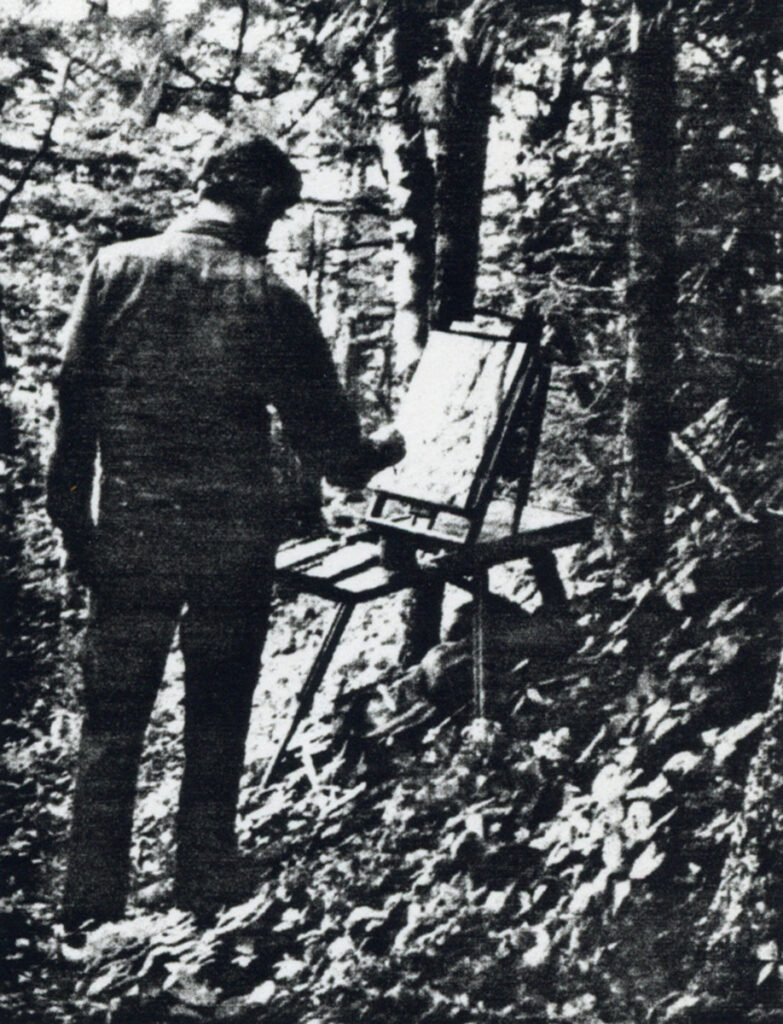
Photograph of Porter painting outdoors. It is estimated that Porter had an output of 2,500 paintings in his long career. When Porter died of a massive heart attack in the backyard of his home in 1975, he was at the height of his painting powers. The converted hayloft that had served as his studio was filled to the rafters with his paintings. Photo credit: Anina Fuller, courtesy Mrs. Fairfield Porter
In 1912, when Fairfield was five, James Porter purchased Great Spruce Head Island in Penobscot Bay, Maine, where he built a farmhouse and large cottage. The Porters spent their summers at the island retreat, and Great Spruce Head fostered Fairfield’s and older brother Eliot’s lifelong reverence for nature. (Eliot, at 81 today, is a world-renowned color photographer and naturalist.) Fairfield eventually inherited the farmhouse and used the wide porch as his summer studio. Many of the paintings completed during the year in Southampton and New York City were initially drawn in Porter’s sparse notational style on Great Spruce Head. Notorious for his eccentric disdain of completed pictures, Porter carted many a canvas back to Southampton with dog hairs, fly wings, and pine needles stuck to the surface. Abrupt changes in temperature and humidity in his open-air salon at the summer studio wreaked havoc with his paintings—warping his canvases.
With no patience for small talk, Porter was famous for leaving tables and galleries without a word of good-bye. When the conversation drifted, Porter would not wait around for new wind. His eccentric exits and quicksilver tongue were familiar trademarks to a powerful circle of artists, poets, critics, and dealers—crucial players who wrote the history of contemporary American art. Porter traveled extensively in Europe as a young man. After mixed success at the Art Students League with teachers Boardman Robinson and Thomas Hart Benton, he pilgrimaged to Italy in 1932 to meet the great Renaissance art historian Bernard Berenson. The twenty-five-year-old Porter had learned of Berenson’s aesthetic theories from Arthur Pope at Harvard and was struck by “B.B.’s” rhapsodizing on the Spanish painter Velázquez. Once Porter was introduced to the Renaissance oil painting medium resurrected by Jacques Maroger, he was able to discard the murky sienna and umber shades that lingered from the social realist 1930s in favor of high-keyed colors, voluptuous to the eye.
A startling preview of his mature style, Self-Portrait (1948), retained some of the gloomy colors that were standard equipment for a generation of American artists. But the composition more than made up for the funeral-gray serge suit that gloved Porter’s erect posture in proper Brooks Brothers fashion. The artist at age forty-one exudes youth and determination. His gaze is framed by a hanging mirror, revealing the spartan details of the studio. A brown tabletop broods in the foreground, its mirrored reflection bouncing back a foursome of cylindrical objects.
Painter Robert Dash knew Porter’s studio well. The two artists met at a Thomas Eakins show at the American Academy and Institute of Arts and Letters in 1958. Both had come to review the exhibit (Porter would later author a monograph on Eakins, published by George Braziller in 1959). Dash told his older colleague that he had just lost his studio on Perry Street. Porter immediately offered the young artist a half share in his Union Square loft.
“It was a huge square room on the top floor,” Dash recalls. “The windows hadn’t been cleaned since Prohibition, but they gave a perfect Venetian northern cathedral light. I painted against one wall; Fairfield worked at the other. I was into abstract expressionism at the time. There was nothing else. Fairfield was doing his thing—I thought at the time a maverick approaching crankiness. Fairfield and I would break for lunch and go across the street to Child’s. For ninety-nine cents we’d get a warmish martini, a steak which was probably horsemeat, potatoes and cole slaw, dessert and coffee. It made one feel very royal indeed, we’d go back to the studio to paint.
“Fairfield never shut up,” Dash continued. “He’d think aloud about paintings he had seen, exhibitions he would visit, all kinds of ideas floated in the air. It was nonstop talk and it used to drive me quite mad. So one day I drew a chalk line down the center of the room and put a radio in the middle and turned the volume way up on a classical station. It was sort of the Maginot Line,” Dash remembered. “That didn’t stop Fairfield. He was madly in love with ideas and, yes, I could hear him above WQXR.”
In addition to being a painter, Porter was a major American art critic, writing some sixty articles for ArtNews and The Nation. A critic absorbed in contemporary issues, he wrote perceptively and enthusiastically on the early work of Willem de Kooning, Larry Rivers, Roy Lichtenstein, Alex Katz, Jane Freilicher, and a host of other New York School painters that were a part of the art scene in the 1950s. Porter’s first review for The Nation, published June 6, 1959, on the paintings of Willem de Kooning at Sidney Janis Gallery, won him the prestigious Longview Foundation prize for art criticism. De Kooning’s wife, Elaine, an important American painter and art critic for ArtNews, was so impressed with Porter that she recommended him to replace her on the magazine.
“With Fairfield talking,” de Kooning observed, “you could have tape recorded his conversation for immediate publication. He never wasted a word and he liked to be controversial. I adored his outspokenness, his clarity of thought.”
With the Boston Museum retrospective, the pell-mell virtuosity displayed in painting the air, in filling a room with textured light, and in taming vast space to intimate dimensions vaults Porter to a position in American painting that proved elusive in his lifetime.
Although he enjoyed modest retrospectives at the Cleveland Museum in 1966 and the Heckscher Museum in Huntington, Long Island, in 1974, Porter could not pierce the rarified atmosphere of a New York City art museum one-man show. The Whitney Museum of American Art will clear this last hurdle on May 30, 1984, the final stop on the Porter tour.
Porter’s widow lives in a new house adjacent to the Southampton home so dear to the artist. Anne Channing Porter is hard at work assisting poet and critic John Ashbery in compiling a volume of her late husband’s poetry. A young artist, Patton Miller, works in the studio behind the big white house. Mrs. Porter thought it was a good idea to keep the studio in use.
Climbing the stairway to the one-time hayloft, an oversized reproduction of Velázquez’s Las Lanzas (The Surrender of Breda, 1638) comes into view, untouched since Porter admired it and had plans to copy it some eight years ago. Looking out the studio window, taking in the autumn grandeur of stately trees and phosphorescent lawns, the world of Fairfield Porter winks in a dappled crescendo of light.
January 12, 1983–March 13: Boston Museum of Fine Arts; April 20–June 19: Greenville County Museum of Art, Greenville, S.C.; July 27–September 25: slot still open—stay tuned; November 9–December 31: Cleveland Museum of Fine Art; February 18–April 22, 1984: Museum of Art, Carnegie Institute, Pittsburgh, Pennsylvania; May 30–July 22: Whitney Museum of American Art, New York, New York.
Judd Tully, who is contributing editor to The New Art Examiner, Art World, and Flash Art, last wrote for Horizon on Roy Lichtenstein.