Andrew Crispo was a high-flying New York dealer until tax evasion and sex scandals brought him low.
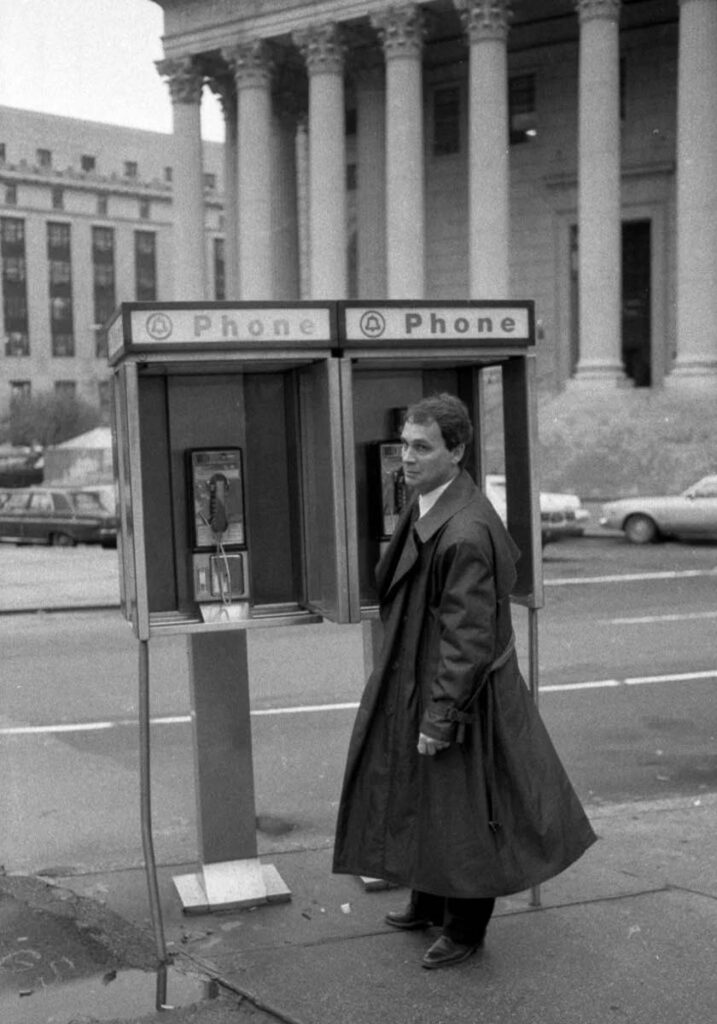
Art dealer Andrew Crispo leaving a pay phone outside the Manhattan Federal Courthouse after pleading guilty to evading more than $4 million in federal income taxes. Photo: Dan Cronin/NY Daily News via Getty Images.
When David Hockney’s 1968 double portrait Christopher Isherwood and Don Bachardy failed to sell at Sotheby’s in 1985—bought in at $570,000 against a $650,000 reserve—few could have predicted that 40 years later, the same painting would roar back at Christie’s, selling for $44.3 million on November 17, becoming the artist’s third-most expensive work at auction.
What went unmentioned in the Christie’s catalogue—but surfaced via Artnet’s reporting days before the sale—was a name missing from its provenance: Andrew Crispo, once a star New York dealer whose impeccable holdings were rivaled only by his increasingly notorious personal life.
The painting’s extraordinary leap, from bought-in liability to multimillion-dollar trophy, has revived interest in the strange, myth-laden rise and fall of Crispo, a dealer whose quicksilver eye and early championing of American Modernism were eventually eclipsed by tax fraud, criminal investigations, and a public downfall unlike anything the New York art world had seen.
Crispo’s Meteoric Rise
Andrew John Crispo was born in Philadelphia in 1945 and raised as an orphan who wound up turning tricks as a tough teenage prostitute around the posh streets of the city’s Rittenhouse Square. The unschooled street survivor was taken under the wing by Henry McIlhenny, the major art collector and chairman of the board of the Philadelphia Art Museum, who tutored Crispo in the arena of Modern art.
Crispo moved to New York City in 1964 and quickly became known as a savvy “runner,” flipping secondary-market art between galleries. He landed a job at the long-established ACA Gallery in 1967, pioneering American Modern and contemporary art dealers and opened his eponymous gallery in 1973.
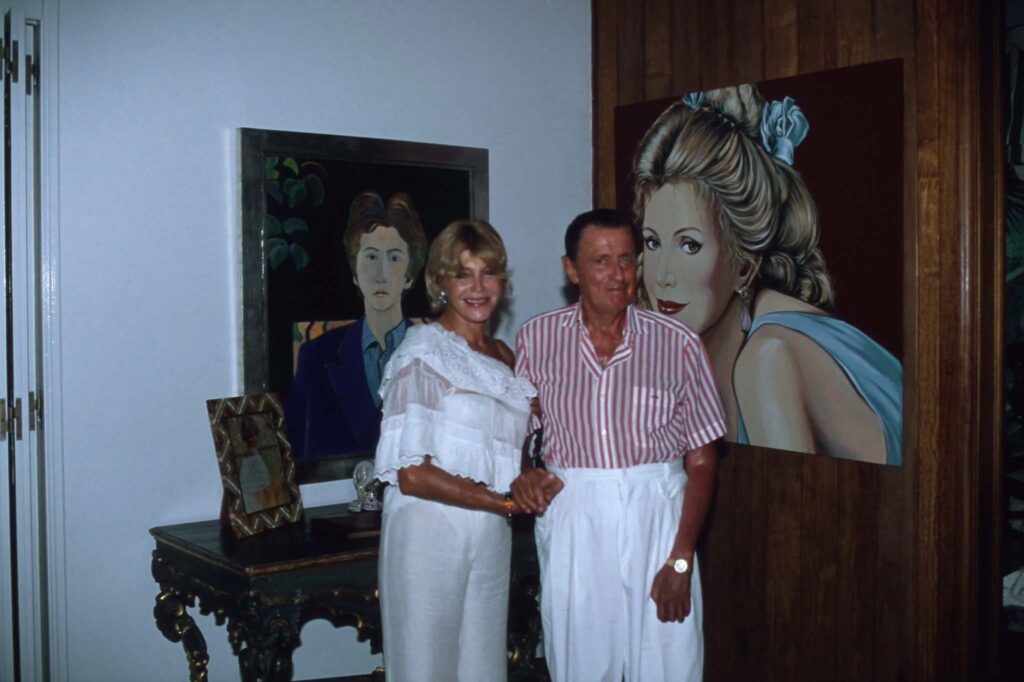
Baron Hans Heinrich Thyssen Bornemisza de Kaszon with wife Carmen Tita Servera in Sant Feliu de Guixols, Spain, 1998. Photo: Wolfgang Kuhn/United Archives via Getty Images.
Among his early and most important clients was Baron Hans Heinrich Thyssen-Bornemisza of Lugano, Switzerland a name synonymous with world-class collecting that burnished the young dealer’s reputation overnight as a dashing mover and shaker.
“He did some really important shows of American Modernism in the 1970s, when it was a kind of void in the market,” said Andrew Schoelkopf of New York’s Schoelkopf Gallery, second-generation specialists in American art. He added that Crispo was “influential” in creating taste and a proper secondary market for artists working in this vein. “It was well-timed and prescient. If you look at the provenance of important American Modernist pictures, he’s there in a lot of them.”
Tax Troubles
But that rise skidded to a temporary halt in 1985 when he plead guilty to federal tax evasion to the tune of $4 million dollars and was sentenced to five years in prison. Crispo admitted in court he had inflated the number of paintings in his inventory so that he could claim greater costs in a given year than he actually had. His personal and gallery inventory of art was sequestered for sale by the IRS and the dealer’s money-lending factor Rosenthal and Rosenthal. All of these financial machinations were breathlessly covered in New York City tabloid press before the advent of the Internet.
“Here is a man,” stated then U.S. Attorney Rudy Giuliani, “who held $4 million from the IRS. For one person that is a tremendous amount of money.”
Though Crispo’s previous ownership of Hockney’s Christopher Isherwood and Don Bachardy was not disclosed in the Christie’s catalogue this season, its failed 1985 auction appearance was part and parcel of his attempts to pay down his tax debt. Artnet’s Katya Kazakina revealed its most recent consignors as Jacqueline and Marc Leland. Mrs. Leland and her former husband, the late financier Gilbert de Botton, had acquired the bought-in Hockney in December 1985 in a private transaction with Sotheby’s, paying $562,500 according to New York art dealer Anthony Grant who worked as a contemporary art specialist for the auction house at the time and who brokered the deal.
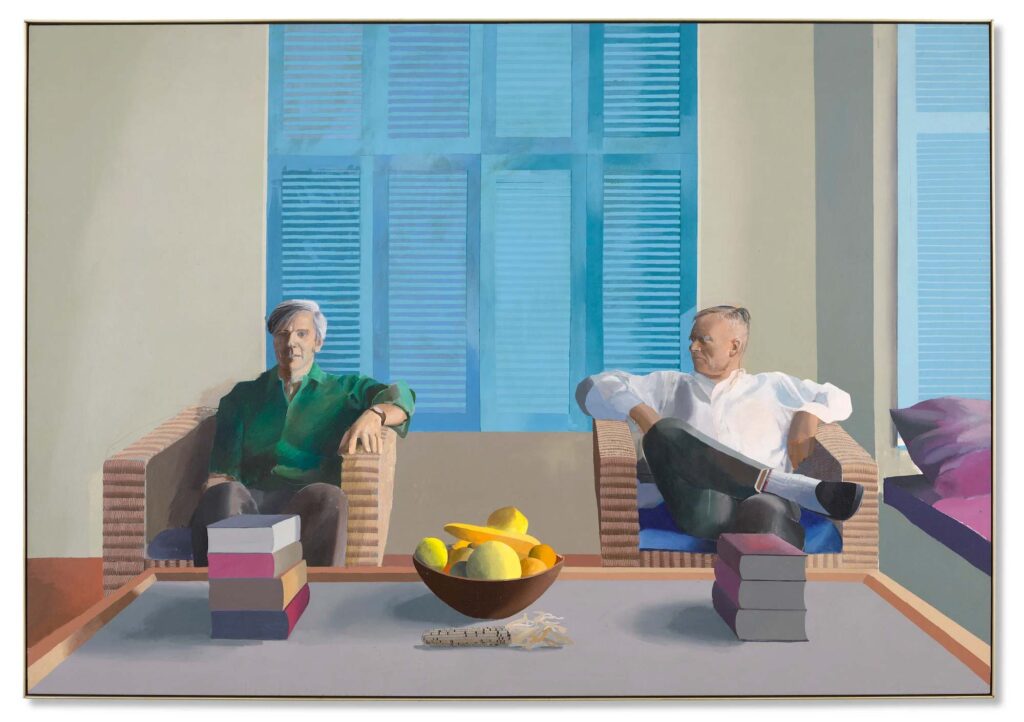
David Hockney, Christopher Isherwood and Don Bachardy (1968). Courtesy of Christie’s.
In fact, Grant visited the 40-year-old Crispo several times to negotiate the consignments ahead of the 1985 auction where he was being held at the Otis Bantam Correctional Center in East Elmhurst New York serving a five-year sentence (of which he only served three).
“We had this really weird relationship,” recalled Grant, “he was so smooth, a snake charmer with a wonderfully seductive voice and very smart. He had great taste and had great things, the best Picassos, the best O’Keeffes. And then there was that other side of him,” alluding to the dealer’s kinky, cocaine fueled private life, for which he had also become known.
Among those great things in his collection, Crispo and his creditors, Rosenthal and Rosenthal, through Sotheby’s had sold a stunning Constantin Brancusi marble “Muse” from 1912 to the Guggenheim Museum in a private transaction for over $2 million in December 1985, just ahead of its upcoming auction. Crispo had acquired it from Ileana Bulova Lindt the former wife of Bulova watch baron Arde Bulova in 1981 for $800,000, some 14 years after the museum lost possession of it after a long-running legal battle. Arde Bulova left the sculpture to the museum in his will and Lindt successfully sued for its return based on her acquisition of it at auction in 1955 for $7,000.
A Crumbling Empire
Crispo’s undisputed triumphs in the art world were serially undermined by his personal behavior. Tax evasion was only part of the dealer’s tabloid headline-generating activities, including questioning by authorities in connection with the sadomasochistic “Death Mask Murder” in 1984 of the 26-year-old Norwegian fashion student and model Eigil Dag Vesti committed by his former gallery assistant Bernard LeGeros, who served 33 years in prison for the killing.
Crispo invoked the Fifth Amendment five times in the courtroom and was never charged in the case, though the 22-year-old LeGeros insisted his former boss participated in the sexual rites that ended in the model’s killing. The .22-caliber rifle that killed Vesti was found hidden in Crispo’s gallery.
“I absolutely deny the charge hinted at that I participated in a murder,” Crispo said at the time in a statement released by his lawyer. “A more professional investigation would have concluded and established that I am not guilty.”
Remarkably, just months before the so-called Death Mask Murder, Crispo was also charged in Manhattan on kidnapping, sodomy, assault, and coercion of Mark Leslie, a 26- year-old Montreal-based English professor. Leslie accused Crispo and three other men of kidnapping and humiliating him at the dealer’s East 57th Street gallery in 1984.
A Manhattan assistant DA at the time characterized Crispo as “a master manipulator who deals in art by day and torture by night.”
Crispo claimed the sex was consensual; a jury acquitted him of charges in 1988.
His controversial lifestyle was consummately documented in David Francis’s sensationally lurid1992 book “Bag of Toys: Sex, Scandal, and the Death Mask Murder.”
Amid all of these legal troubles, Crispo’s art empire was crumbling, and he closed his posh, duplex gallery in the prestigious Fuller Building, where he dealt master works alongside blue-chip dealers Pierre Matisse, Andre Emmerich, and David McKee.
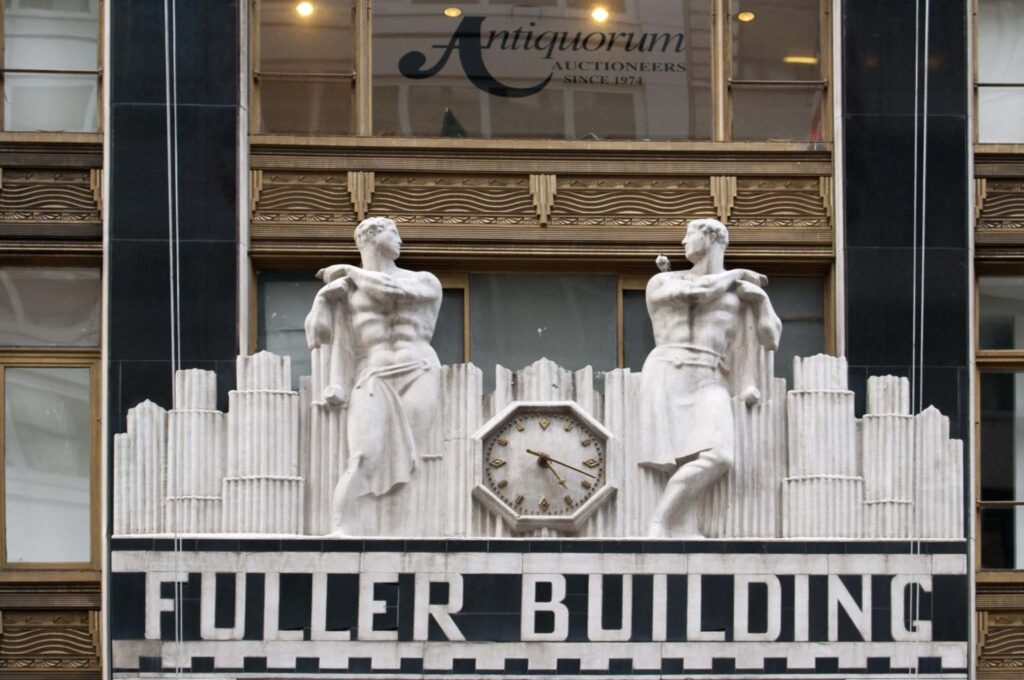
The Fuller Building is an office skyscraper in Manhattan located at 41 East 57th Street on the corner of Madison Avenue. The Art Deco building houses many galleries in midtown Manhattan. Photo: Sergi Reboredo/ VW PICS/ Universal Images Group via Getty Images.
“I was in his space when it was raided by authorities, right after Crispo was arrested and they ransacked the gallery searching for documents,” said New York dealer Doug Walla.
“There were rooms painted black and had secret passageways. It was like a party space with graffiti covering the walls.”
Walla and his company Kent Fine Art took over Crispo’s space in September 1985 and gut renovated it.
A Collection, Scattered and a Legacy, Lost
Crispo and his creditors, Rosenthal and Rosenthal (now relaunched as Rosenthal Capital Group), had decidedly more success paying off the dealer’s debt to the IRS at Sotheby’s American Paintings, Drawings and Sculpture auction on December 3, 1987 where 62 works from his collection realized a whopping $12.5 million.
Among the highlights was the cover lot, Edward Hopper’s Captain Upton’s House from 1927, which fetched a record $2.3 million, selling to Hirschl and Adler Gallery on behalf of collector Steve Martin. Hopper’s Hotel Window (1956), formerly in the collection of Baron Thyssen Bornemisza, sold for $1.3 million to Malcolm Forbes, and Georgia O’Keeffe’s 1929 At the Rodeo, New Mexico fetched $1.4 million, doubling its high estimate of $700,000.
In a jailhouse handwritten letter to this reporter, dated a week before the 1987 auction with his return address on the envelope as M.H.D 11 E (initials for the Manhattan House of Detention), 125 White Street, Crispo wrote, “…what I hope to achieve is to be able to fulfill the promise of repayment that I made to the Government. I felt that an auction would achieve the best results. I have carefully chosen the works of art from my collection both personal and gallery. Each has been a constant source of pleasure to me for a very long time.”
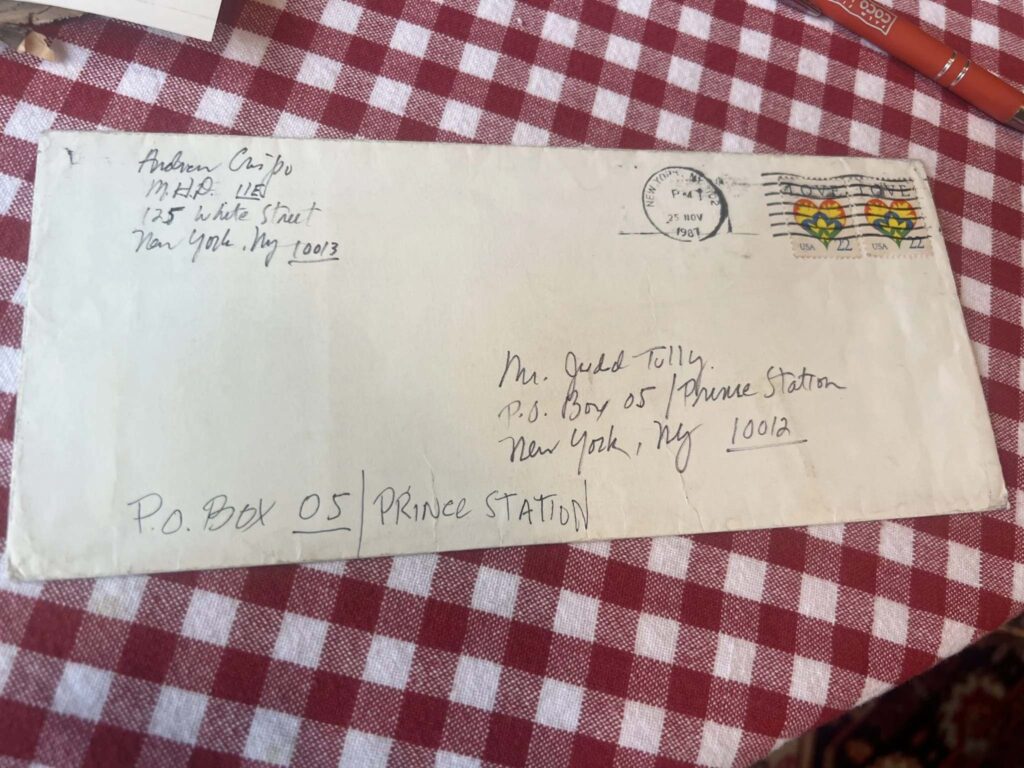
Correspondence from Crispo to Judd Tully, circa 1987. Photo: Judd Tully.
Crispo’s headline-making life took another sharp turn just days after his release from prison in 1989 when his Southampton, New York, house shared with his long-time companion, the noted interior decorator Arthur E. Smith, blew up and burnt to the ground from a gas explosion that also destroyed the artworks hanging in their home. Crispo eventually received a $5 million settlement from the Long Island utility company that provided gas to the house and used some of the proceeds to buy a new home in Charleston South Carolina, known as the Pineapple Gate House.
But that home also had to go in a later bankruptcy filing and it sold to its creditors for a record $3.1 million in 1996.
An unrealized attempt in the late ’90s to open a huge, sculpture focused gallery in Manhattan’s soon-to-be-trendy Meatpacking district sent the dealer to financial ruin and relative obscurity. In 1999, just before its planned opening, Crispo was arrested again, this time for threatening to kidnap the four-year-old daughter of a lawyer involved in his bankruptcy case. A judge denied him bail, citing a risk of “irrational conduct.” He was convicted and sentenced in 2000 to seven years in prison and released in 2005.
After his release, Crispo bought property in Fort Greene, Brooklyn, intending to open yet another gallery. The plan failed and by 2017 he faced bankruptcy again, defaulting on loans backed by his co-op shares and art. The lender took over the apartment, but Crispo refused to leave and delayed eviction through legal maneuvers and the pandemic-era eviction moratorium. His appeal was still pending when he died destitute in a nursing home in February 2024. The New York Times obituary headlined his passing, “Andrew Crispo, Disgraced Manhattan Gallery Owner, Dies at 78.”